
What Makes a DIN Rail Mount Miniature Circuit Breaker Essential for Reliable Electrical Protection?
2026-10-10
Electrical systems in residential buildings, commercial facilities, and industrial environments require dependable protection against abnormal current conditions. Overloads and short circuits can damage equipment, interrupt production, and increase the risk of electrical fires. A DIN Rail Mount Miniature Circuit Breaker provides an effective way to disconnect a circuit when potentially dangerous overcurrent conditions occur. Its compact design, standardized mounting method, and convenient operation make it an important component in modern electrical distribution systems. For electrical equipment manufacturers, panel builders, contractors, and distributors, selecting the right miniature circuit breaker is essential to achieving reliable performance and efficient installation. Zhejiang Pugao Electric Power Co., Ltd. serves the electrical equipment market with a focus on practical circuit protection solutions for different project requirements.
1. What Is a DIN Rail Mount Miniature Circuit Breaker?
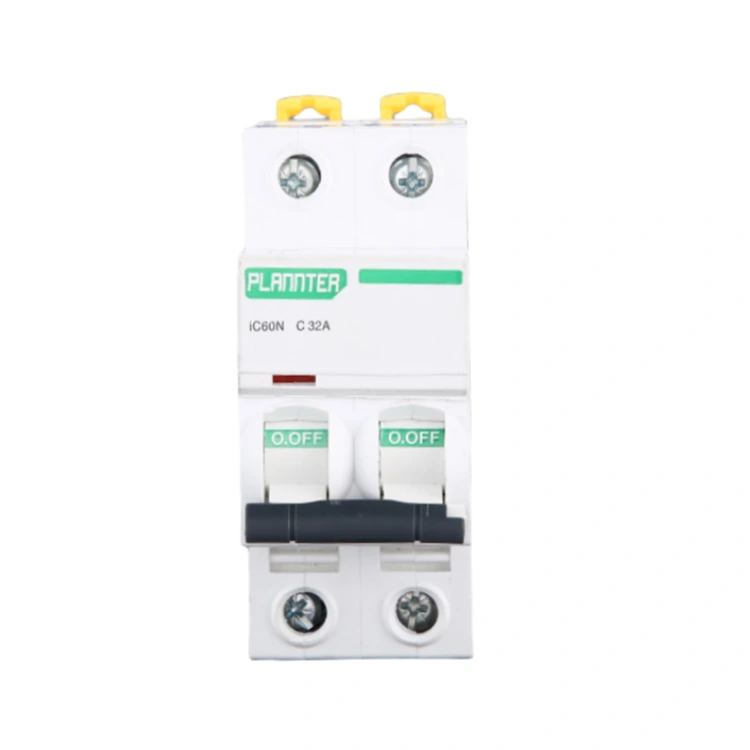
A DIN rail mount miniature circuit breaker (MCB) is an automatic electrical protection device installed on a compatible DIN rail inside a distribution board, control cabinet, or electrical enclosure. It monitors current flowing through a circuit and disconnects the supply when an overload or short circuit exceeds its operating characteristics.
Unlike a conventional fuse, an MCB can generally be reset after the fault has been identified and resolved, provided the device remains serviceable and the manufacturer's instructions permit reuse.
How Does It Work?
Most conventional AC miniature circuit breakers use a thermal-magnetic tripping mechanism.
-
Overload protection: A thermal element responds to sustained excessive current and trips the circuit to help prevent conductor overheating.
-
Short-circuit protection: A magnetic mechanism responds rapidly to a high fault current and opens the circuit.
-
Manual switching: The operating handle allows users to switch a circuit on or off for normal operation and appropriate maintenance procedures.
These functions help protect electrical wiring and connected equipment from overcurrent damage. However, an MCB does not replace every form of electrical protection; additional devices may be necessary for earth-leakage protection, surge protection, or other application-specific risks.
2. Why Is a DIN Rail Mount Miniature Circuit Breaker Important?
Improving Electrical Safety
Electrical faults can develop unexpectedly in lighting circuits, power distribution systems, machinery, and control panels. A properly selected MCB helps disconnect affected circuits before excessive current causes more extensive damage.
Its rated breaking capacity must be sufficient for the prospective short-circuit current at the installation point. Correct coordination with conductors and upstream protection devices is equally important for dependable protection.
Simplifying Installation and Maintenance
Standard DIN rail mounting allows compatible modular circuit breakers to be installed neatly alongside other electrical components. This arrangement supports organized wiring, efficient cabinet assembly, and easier replacement when maintenance is required.
Clear circuit labeling and accessible operating handles also help technicians identify and isolate the relevant circuit more efficiently.
Supporting Operational Continuity
When circuits are divided into appropriate protective groups, a fault in one branch may be isolated without unnecessarily interrupting unrelated circuits, depending on the system's protective coordination. This is particularly valuable in commercial buildings, industrial control cabinets, and equipment distribution systems where unnecessary downtime can affect productivity.
3. What Features Should Buyers Evaluate?
Not every miniature circuit breaker is suitable for every electrical installation. Buyers should compare the following specifications before making a purchasing decision.
| Key parameter | Why it matters |
|---|---|
| Rated current | Must match the circuit design, cable capacity, and expected load |
| Rated voltage | Must be compatible with the electrical system |
| Number of poles | Determines the conductors switched and protected by the selected configuration |
| Tripping curve | Helps match the breaker to the load's normal starting and inrush currents |
| Breaking capacity | Must meet or exceed the applicable prospective fault-current requirement |
| Mounting compatibility | Ensures secure installation on the intended DIN rail |
| Applicable standards | Helps establish suitability for the target market and installation |
Choosing the Appropriate Tripping Curve
B, C, and D curves are common options for different applications, although their suitability depends on the specific product and applicable standard.
-
B curve: Often considered for circuits with relatively low inrush current, such as many lighting and residential applications.
-
C curve: Commonly used for general-purpose circuits and certain loads with moderate starting currents.
-
D curve: May suit loads with high inrush currents, provided the installation's fault-loop conditions and protection requirements allow it.
The correct curve should be determined through electrical design rather than selected solely on the type of equipment being powered.
4. Where Can DIN Rail Mounted MCBs Be Used?
The versatility of a DIN Rail Mount Miniature Circuit Breaker makes it suitable for a broad range of low-voltage applications.
Residential buildings
-
Lighting and socket circuits
-
Household appliance distribution
-
Branch circuit protection in distribution boards
Commercial facilities
-
Office electrical panels
-
Retail lighting and power circuits
-
Building service and equipment distribution
Industrial environments
-
Machine control cabinets
-
Auxiliary power circuits
-
Manufacturing equipment and automation systems
Electrical distribution projects
-
Modular distribution boards
-
Control panels and electrical enclosures
-
Equipment assemblies requiring organized branch protection
The final application must always remain within the product's rated electrical and environmental limits.
5. How Can Buyers Select the Right MCB for Their Projects?
A structured selection process can help reduce specification errors and improve purchasing efficiency.
-
Define the electrical requirements. Confirm the system voltage, frequency, load current, and AC or DC application.
-
Check cable protection requirements. Select a rated current appropriate for the conductor, installation method, ambient conditions, and expected load.
-
Evaluate fault conditions. Verify that the rated breaking capacity meets the prospective short-circuit current.
-
Choose the pole configuration. Determine whether a single-pole, double-pole, three-pole, or four-pole arrangement is required.
-
Confirm mounting and wiring compatibility. Check DIN rail dimensions, terminal arrangements, conductor sizes, and accessory requirements.
-
Review compliance documentation. Confirm applicable standards, test reports, certifications, and destination-market requirements.
For OEMs, panel builders, and electrical distributors, confirming these details before ordering can also simplify product matching, inventory planning, and project coordination.
6. Why Consider Zhejiang Pugao Electric Power Co., Ltd.?
For buyers sourcing electrical protection components, product suitability, technical communication, and consistent supply are important considerations.
Zhejiang Pugao Electric Power Co., Ltd. is a potential sourcing partner for businesses evaluating miniature circuit breakers and related electrical protection products. When assessing a supplier, professional buyers should review the available product catalog, technical specifications, quality documentation, production capabilities, and export support.
For project-based purchasing, it is also useful to confirm the availability of required current ratings, pole configurations, tripping characteristics, packaging options, and documentation before placing an order. Any required customization or OEM arrangement should be discussed and verified directly with the supplier.
A well-matched product and a clear technical specification can help buyers build more reliable electrical assemblies while improving procurement efficiency.
7. What Is the Long-Term Value of Choosing the Right Circuit Breaker?
A suitable miniature circuit breaker offers more than basic overcurrent protection. It supports organized electrical distribution, convenient circuit isolation, and more manageable maintenance. When selected according to the actual electrical conditions, it can help reduce avoidable equipment damage and support stable system operation.
Nevertheless, product quality alone cannot compensate for incorrect sizing, unsuitable installation, or inadequate protective coordination. Qualified electrical professionals should verify the complete protection design and follow the relevant installation standards.
Conclusion: Find a Suitable DIN Rail Mount Miniature Circuit Breaker
Choosing the right DIN Rail Mount Miniature Circuit Breaker is an important step toward safe, efficient, and dependable low-voltage electrical distribution. By evaluating rated current, voltage, pole configuration, tripping characteristics, breaking capacity, and compliance requirements, buyers can identify a solution that better matches their application.
Looking for a suitable circuit protection solution for your next project? Contact us at Zhejiang Pugao Electric Power Co., Ltd. to discuss your application requirements, review available product specifications, and explore suitable miniature circuit breaker options for your electrical distribution needs.