
What Are the Main Differences Between a GGJ Reactive Power Compensation Cabinet and Other Compensation Systems
2026-10-21
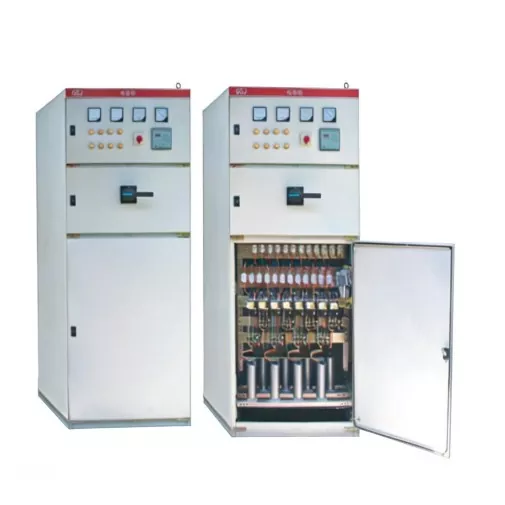
Selecting the right reactive power solution directly affects power factor performance, energy costs, and network stability. A GGJ Reactive Power Compensation Cabinet from Junray is a low-voltage, integrated compensation system that combines capacitors, reactors, switching devices, and intelligent control in a single enclosed cabinet. This article compares it with other common compensation systems so you can evaluate fit, safety, and long-term value with confidence.
1. Comparison at a Glance
| Feature | GGJ Reactive Power Compensation Cabinet | Fixed Capacitor Bank | Synchronous Condenser | SVG / Active Filter |
|---|---|---|---|---|
| Compensation mode | Stepped, automatic switching | Fixed, manual | Continuous, rotating machine | Continuous, power electronics |
| Response speed | Fast (step-based) | Slow | Moderate | Very fast |
| Harmonic handling | Improved with series reactors | Limited | Good | Excellent |
| Footprint | Compact cabinet | Panel-based, modular | Large | Compact |
| Maintenance | Routine inspection | Low but frequent switching wear | High (rotating parts) | Moderate (electronics) |
| Typical use | Industrial plants, buildings, distribution networks | Simple loads | Grid-level stability | Sensitive or harmonic-rich loads |
2. Key Differences
-
Integration: The GGJ Reactive Power Compensation Cabinet arrives as a tested, factory-assembled unit, reducing on-site wiring and commissioning risk compared with loose capacitor banks.
-
Automatic control: Intelligent controllers switch capacitor steps based on measured power factor, unlike fixed banks that cannot adapt to changing loads.
-
Harmonic protection: Series reactors and suitable capacitor ratings make the GGJ Reactive Power Compensation Cabinet safer in networks with nonlinear loads.
-
Cost balance: It costs more than fixed banks but far less than SVG systems, offering strong return on investment for typical low-voltage compensation.
-
Safety design: Enclosure, ventilation, and protection coordination are engineered together, supporting compliance and operational safety.
3. Selection Guidance
-
Choose a GGJ Reactive Power Compensation Cabinet for stable low-voltage networks with variable loads and moderate harmonic content.
-
Choose fixed banks only for constant, simple loads.
-
Choose SVG or active filters where harmonics and flicker dominate.
-
Choose synchronous condensers mainly for transmission-level or inertia needs.
FAQ
Q: What loads suit a GGJ Reactive Power Compensation Cabinet?
A: It suits low-voltage industrial, commercial, and distribution networks with variable inductive loads, such as motors, pumps, and HVAC systems, where automatic stepped compensation and moderate harmonic protection are required.
Q: Can a GGJ Reactive Power Compensation Cabinet work with harmonic-rich loads?
A: Yes, when configured with appropriate series reactors and detuned capacitor ratings, it tolerates common harmonic levels; for severe distortion, combine it with filtering equipment after a network study.
Q: How is maintenance handled for a GGJ Reactive Power Compensation Cabinet?
A: Maintenance involves periodic inspection of capacitors, reactors, contactors, ventilation, and controller settings, plus tightening connections and checking protection operation to keep performance and safety stable.
Talk to Junray about your load profile and power factor targets. Our engineers can size and configure a GGJ Reactive Power Compensation Cabinet that matches your network, so contact us today for a tailored recommendation and quotation.