
How Does the Interlock Mechanism Work in Medium Voltage Indoor Ground Switches and Earth Switches
2026-03-31
Ensuring absolute safety in power distribution networks begins with a single non-negotiable principle: preventing operator error. For engineers and facility managers working with Medium-voltage Indoor Ground Switch Earth Switch assemblies, the interlock mechanism is not merely a feature—it is the cornerstone of operational integrity. At Wzonpa, we design these mechanical and electrical safety systems to enforce a strict sequence of operations, ensuring that isolation, grounding, and closure procedures occur in a fail-safe order. Without a properly functioning interlock, the risk of accidental energization during maintenance or a short-circuit fault during switching becomes unacceptably high.
The Core Principles of Mechanical Interlocking
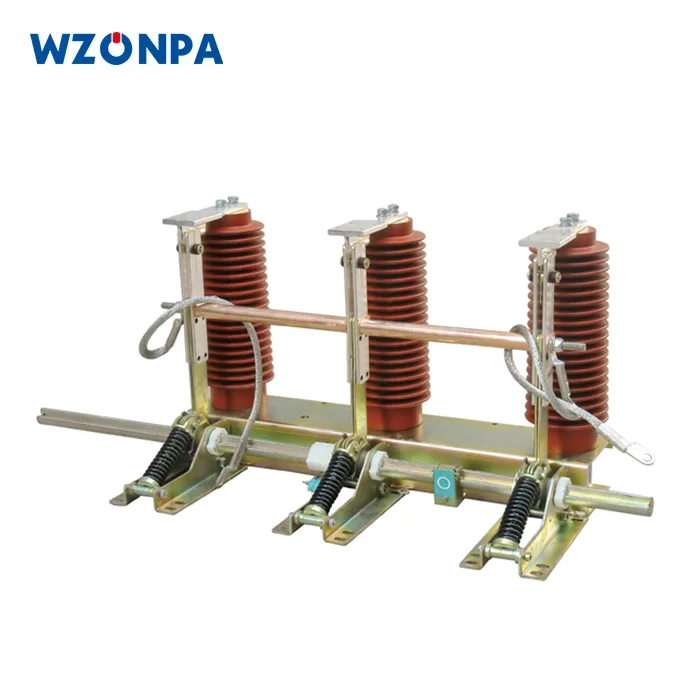
The interlock mechanism in a Medium-voltage Indoor Ground Switch Earth Switch operates on a simple yet rigorous logic: the device physically prevents the operator from performing a step that would create a hazardous condition. Typically, this involves a key-based or lever-based system that ties the status of the circuit breaker, the isolating switch, and the earthing switch into a single sequence.
For example, in a typical Wzonpa unit, the interlock ensures that the earth switch cannot be closed while the main isolating switch is in the "closed" position. Conversely, the isolating switch cannot be opened unless the circuit breaker on the load side is first tripped and racked out. This "five-step" safety protocol is mandated by international standards such as IEC 62271-102, and it is physically enforced through mechanical cams, steel rods, and lock plates that will not budge if the sequence is violated.
Types of Interlock Mechanisms
To accommodate different operational environments, manufacturers employ various interlock structures. The table below outlines the primary types used in modern medium-voltage equipment:
| Interlock Type | Mechanism | Primary Application |
|---|---|---|
| Mechanical Key | Uses a removable key that is trapped until a specific condition (e.g., switch open) is met. | Ideal for distributed systems where multiple panels must be locked in a specific sequence. |
| Sliding Bolt | A physical bolt or plate slides into position to block the operating handle or shaft. | Common in fixed-type switchgear for simple, dedicated interlocking between two components. |
| Cam and Rod | A rotating cam pushes connecting rods that lock or unlock the adjacent switching mechanism. | Used in integrated Medium-voltage Indoor Ground Switch Earth Switch units for compact, reliable operation. |
| Electrical (Auxiliary Contact) | Uses auxiliary contacts to cut control power, preventing electrical operation if mechanical conditions are not met. | Serves as a secondary layer of safety, often paired with mechanical interlocks for redundancy. |
Why Mechanical Interlocks Outperform Electronic Reliance
While modern switchgear incorporates sophisticated relays, Wzonpa emphasizes that a robust mechanical interlock remains irreplaceable. Electronic controls can fail due to auxiliary power loss or electromagnetic interference; however, a mechanical interlock is passive. It does not require a battery to function. In a Medium-voltage Indoor Ground Switch Earth Switch, this physical barrier ensures that even if the control circuitry is damaged, the operator cannot physically close the earth switch onto a live circuit. This alignment with the EEAT principle—demonstrating Experience, Expertise, Authoritativeness, and Trustworthiness—is why utilities and data centers prioritize mechanically interlocked Wzonpa solutions for critical infrastructure.
Common Integration Scenarios
Interlocks are not standalone components; they integrate the entire switchgear assembly. Typically, the interlock mechanism connects three main functions:
-
Circuit Breaker Position: The interlock ensures the breaker is in the "test" or "disconnected" position before the earth switch can be operated.
-
Cable Compartment Access: The rear cable compartment door cannot be opened unless the earth switch is closed, grounding the cables.
-
Padlocking Facilities: Provision for multiple padlocks allows maintenance teams to apply their own personal lockout-tagout (LOTO) devices, overriding the standard mechanical interlock during extended maintenance windows.
Frequently Asked Questions (FAQ)
What happens if I try to close the earth switch while the main switch is still in the closed position?
The mechanical interlock system physically prevents the operating lever from engaging with the earth switch shaft. In a Wzonpa Medium-voltage Indoor Ground Switch Earth Switch, a hardened steel interlock plate is linked to the main switch spindle. If the main switch remains closed, this plate obstructs the earth switch handle insertion point. You will find it impossible to insert the handle or rotate it more than a few degrees. This is a mandatory safety feature to prevent a catastrophic phase-to-ground fault.
How does the interlock mechanism ensure that the circuit breaker is racked out before I can open the cable compartment?
The interlock utilizes a multi-step sequence involving both mechanical shutters and auxiliary contacts. First, the auxiliary contacts confirm the breaker is in the "disconnected" position. Once confirmed, a mechanical rod releases the shutter over the cable compartment. However, the final release of the door latch is still tied to the earth switch position. The cable compartment door will only unlock after the Medium-voltage Indoor Ground Switch Earth Switch has been physically closed and grounded. This ensures that anyone entering the cable compartment is protected from induced voltages or back-feed.
Can I add a personal lockout device to the interlock mechanism during maintenance?
Yes, Wzonpa designs all interlock mechanisms with dedicated padlock hasps. After the interlock has performed its function—such as locking the earth switch in the closed position—operators can attach up to three separate padlocks to the mechanism. This feature allows multiple maintenance teams to apply their own lockout-tagout devices simultaneously. Even if the site supervisor’s key is turned or the control power is restored, the physical padlocks prevent the interlock from disengaging until every authorized worker has removed their lock.
Ensuring Long-Term Reliability
For a Medium-voltage Indoor Ground Switch Earth Switch, the interlock mechanism is subject to mechanical wear over its lifecycle. Regular inspection should focus on the alignment of operating rods, the integrity of key traps, and the smooth operation of sliding bolts. Wzonpa manufactures these components from corrosion-resistant stainless steel and self-lubricating polymers to ensure consistent operation even after thousands of switching cycles. Proper lubrication and periodic functional testing—typically every 12 to 24 months—will guarantee that the interlock continues to enforce the safety sequence without false blocking or unintended release.
Conclusion
Understanding the interlock mechanism is essential for anyone responsible for the safe operation of medium-voltage distribution systems. By physically enforcing the correct sequence of operations, these mechanisms eliminate the risk of human error during switching and maintenance. With a focus on robust mechanical design and user safety, Wzonpa provides Medium-voltage Indoor Ground Switch Earth Switch solutions that meet the highest international standards, ensuring that operators are always protected by a fail-safe system.
For detailed technical specifications or to discuss a custom interlock configuration for your project, contact us today to speak with a Wzonpa engineer about your medium-voltage safety requirements.