
Top 10 Mining Air Compressors for Heavy-Duty Operations
2026-10-20
When heavy-duty mining operations push equipment to the limit, air compressors often make or break daily productivity. Choosing the right unit isn't just about horsepower—it's about surviving dust, moisture, extreme temperatures, and round-the-clock cycles. That’s why we’ve cut through the noise to rank the top 10 mining air compressors that truly deliver in harsh conditions. Our list covers everything from rugged portable models to high-volume stationary systems, with side-by-side comparisons of durability, air output, and maintenance costs. You’ll also find trusted names like Seize Air, whose heavy-duty designs keep underground and surface mines running without surprises. Whether you're replacing a failing compressor or planning a new site, this guide gives you the real-world insights needed to pick a machine that won't let you down.
Why a Standard Shop Compressor Fails Quickly in a Working Mine
Shop compressors are built around short bursts of work followed by cool-down periods, which has little in common with the nonstop air demand inside a working mine. The pump and motor get pushed well past their intended duty cycle, so heat builds faster than the small cooling fins and splash lubrication can shed it. Within days or weeks, the oil thins, ring and bore wear accelerates, and the motor insulation starts to degrade. What survives in a garage simply cooks itself underground.
Mine air is full of fine, abrasive dust that clogs intake filters and coats every hot surface. That layer acts like a blanket, raising cylinder head temperatures and forcing the compressor to work harder with each stroke. Dust also mixes with oil to form a grinding paste on rods, pistons, and bearings. Standard paper filters and low-volume air intakes were never meant to handle that kind of particle load, so filtration becomes a bottleneck before the compressor itself gives out.
Moisture and unstable power finish the job. Humidity in underground workings condenses inside the tank and lines, and without automatic drains or a proper dryer the receiver becomes a rust factory. Acidic water pits the tank floor and sends flakes into valves and seals. Add voltage drop from long cable runs or generator supply, and the motor starts pulling higher current while producing less torque. Repeated trips and weak starts hammer the windings until the unit fails, often long before the first scheduled service.
Piston, Rotary Screw, or Centrifugal - Three Ways to Feed a Mine's Air Hunger
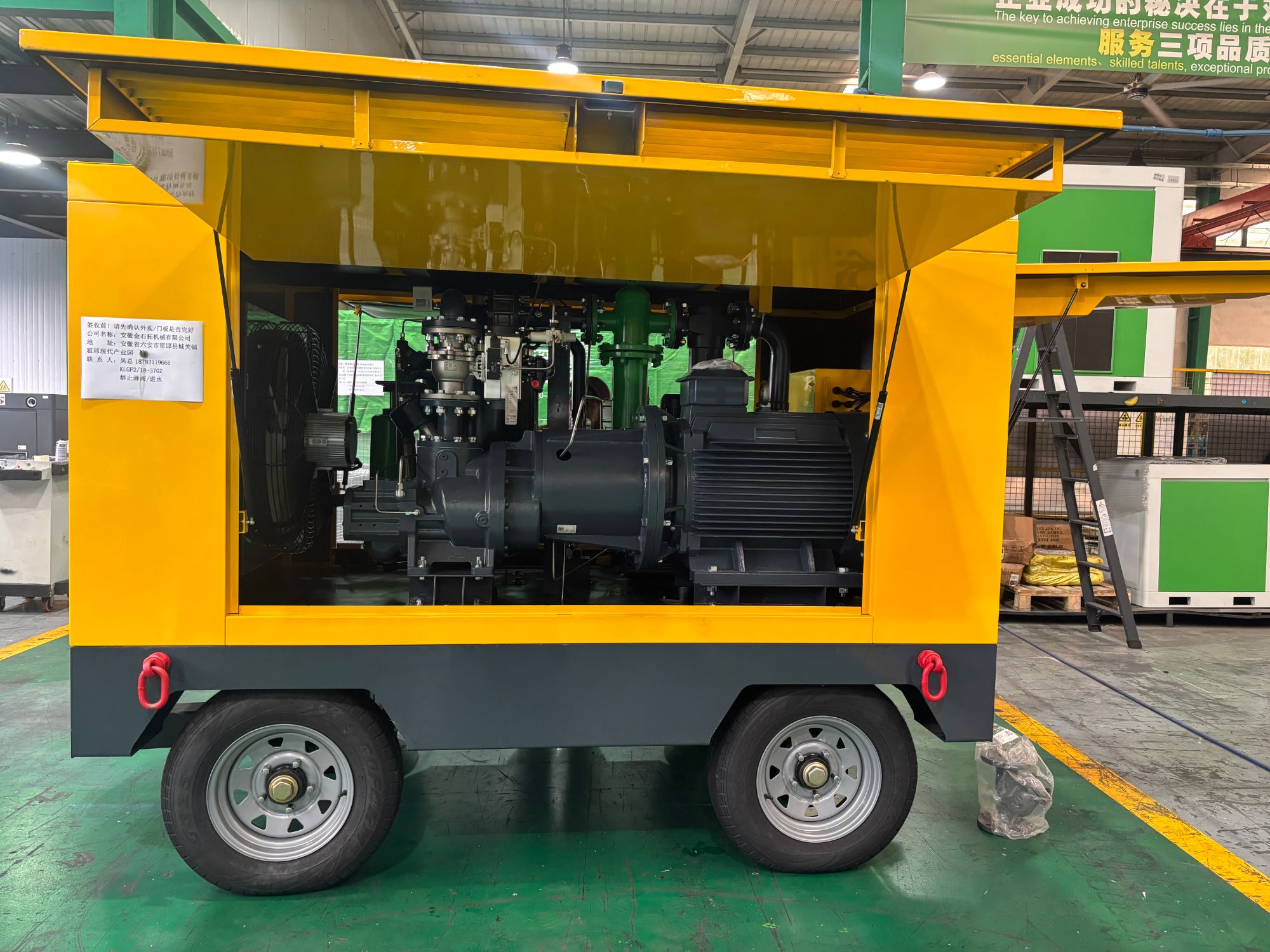
Mines breathe through their compressors, and the choice between piston, rotary screw, and centrifugal technology shapes how reliably that breath arrives. Piston machines work like a bicycle pump scaled up for heavy industry, using a crankshaft and cylinder to squeeze air in discrete pulses. They tolerate dirty, high-temperature environments and still make sense for small operations where intermittent demand and simple maintenance matter more than energy efficiency. The trade-off is vibration and a staccato output that requires a large receiver tank to smooth out pressure swings.
Rotary screw compressors changed underground expectations by delivering a steady stream of compressed air without the hammering. Two intermeshing rotors trap air and reduce its volume along the screw profile, producing a nearly pulse-free flow. Mines favor them for mid-range duties: they run cooler than pistons, fit into tight drifts, and handle continuous loads without the thermal stress that shortens piston ring life. Variable speed drives let a screw compressor match output to changing ventilation or drill demand, trimming power costs when the face is quiet.
Centrifugal compressors operate on a different principle entirely, accelerating air with a high-speed impeller and then converting that velocity into pressure. They shine when a mine needs enormous volumes at moderate pressure, such as main surface plants feeding a whole underground network. Their efficiency curve peaks at full load, so they are not ideal for stop-start duty, but in a 24-hour operation they can outperform positive-displacement machines on energy per cubic meter. The catch is sensitivity to inlet conditions and a narrower operating window, which demands careful sizing and clean intake air to avoid surging.
How a CFM Miscalculation Can Starve Jackleg Drills and Loaders Mid-Shift
Mistakes in CFM calculations rarely announce themselves until the afternoon shift, when a jackleg drill suddenly loses bite and a loader’s arms sag mid-cycle. The root cause is often an honest but costly oversight: using the compressor’s rated output instead of its usable delivery at the end of a long hose run, forgetting to subtract the air consumed by other tools on the same line, or ignoring elevation and temperature derating. A mine at 10,000 feet, for instance, can lose nearly a third of a compressor’s sea-level CFM before the first coupling. When the math ignores that, the header pressure drops far below what the drill’s manufacturer calls for, and the tool starves while the compressor works flat out.
Jackleg drills are particularly unforgiving. They need a steady blast of air to both hammer and clear cuttings from the hole; if the CFM falls short, the piston loses stroke speed, the bit stalls in the rock, and the operator has to back out and re-enter repeatedly. Loaders, on the other hand, fail more subtly. Their air motors may still cycle, but at reduced torque, so the bucket hesitates under full load and the crowd function feels spongy. Before long, both machines are cycling at half their designed rate, and the crew is waiting on air rather than breaking ground. Mid-shift, that idle time compounds quickly, because every wasted minute on the face pushes the rest of the cycle—blasting, mucking, bolting—further into overtime.
The fix isn’t simply buying a bigger compressor. It means measuring actual consumption at the tool inlet with a gauge, accounting for every fitting, whip hose, and manifold restriction, and then adding at least a 20 percent safety factor for tool wear and simultaneous loads. On sites where two jacklegs and a loader share one line, a CFM miscalculation of just 40 or 50 can turn a productive heading into a bottleneck. Those who’ve been caught know the telltale sign: the drill’s exhaust note thins out, the loader’s controls feel lazy, and someone starts checking the fuel level instead of the math.
Diesel, Electric, or Both - The Power Decision That Dictates Uptime and Air Quality
Choosing between diesel and electric power isn't just a matter of fuel preference—it reshapes how operations handle downtime, ventilation costs, and long-term reliability. Diesel brings raw torque and quick refueling for remote or high-demand sites, but it also forces you to manage exhaust, particulate filters, and stricter air quality compliance. Electric eliminates emissions at the point of use and slashes noise, yet it ties you to charging infrastructure and battery life cycles that can quietly eat into uptime if not planned around actual duty cycles.
A hybrid or dual-power strategy often gets overlooked because it sounds complex, but mixing both lets you reserve diesel for peak loads or emergency backup while running electric for routine low-intensity work. The real decision point is how your operation breathes: if air quality is a hard constraint—underground mining, enclosed warehouses, populated job sites—electric becomes less of an option and more of an operational necessity. If you're constantly moving between off-grid locations with unpredictable power access, diesel redundancy still earns its keep.
What tips the balance is measuring not just engine specs, but the true cost of lost minutes: battery swaps, cord management, regeneration cycles, and diesel particulate filter regens all create hidden pauses. Map a typical week of work against each power source's failure modes before committing. Sometimes the biggest uptime win isn't going all-electric or all-diesel, but designing a transition plan that lets you phase in electric where it fits today without stranding your diesel assets where they still outperform.
What Actually Breaks First When Dust and Moisture Meet a Heavy-Duty Compressor
The intake filter assembly is usually the first casualty. Dust alone drives up restriction across the element, but when moisture hits the media, the paper swells and traps fine particles even faster. The pressure differential gauge starts twitching long before any bypass valve lifts, and that unfiltered slipstream is what quietly hands the damage downstream.
The next thing to degrade is the lubricating oil itself. A small amount of moisture emulsifies with the oil under load, thinning the film strength at the crankpin and main bearings. You won't hear knocking right away; instead, the oil level creeps up slightly and the color shifts gray or milky. Those micro-pits on bearing shells start forming well before any visible scoring appears on cylinder walls.
So the honest answer to what breaks first is rarely a piston or valve plate. It's the filtration barrier and the oil's protective chemistry. Watch for a bouncing differential gauge, a gradual rise in oil level, and any change in oil clarity. Those signals show up days or even weeks before hard mechanical failure announces itself.
The Service Intervals That Matter Most When Downtime Costs More Than Parts
In operations where every idle hour bleeds revenue, the traditional maintenance calendar becomes a liability. You stop asking “How long can this component run?” and start asking “What failure would cost me the most right now?” That shift in thinking redraws the map—critical hydraulic filters, battery health in emergency backups, and thermal wear on high-cycle motors suddenly jump ahead of routine oil changes that can wait a weekend.
The intervals worth tracking closely are rarely the ones printed in the manual. They live at the intersection of load spikes and environmental stress. A generator running near capacity during a heat wave doesn’t need a quarterly glance; it needs vibration checks every 400 operating hours, with coolant chemistry sampled twice as often as the baseline. Similarly, conveyor chain tension in a 24/7 fulfillment center deserves a shorter leash than the same chain in a daytime-only warehouse, because a snapped link at 3 a.m. costs ten times the replacement part.
Smart teams build a two-tier schedule: the cosmetic upkeep that can flex, and the survival list that cannot. The survival list gets locked to actual runtime, not calendar days, and it gets reviewed after every near miss. When a bearing shows a two-degree temperature rise over its rolling average, that’s not a scheduled service point—that’s a warning shot. Treat those signals as non-negotiable intervals, and downtime stops being a surprise expense. It becomes a number you already planned around.
FAQ
Mining compressors are built for constant abuse—thick dust, extreme temperatures, rough transport, and nonstop shifts. You'll see heavier filtration, reinforced frames, larger coolers, and often higher IP-rated electrical enclosures. A standard shop compressor simply won't survive being dragged over haul roads or left running in a drift with poor ventilation.
Think of cfm as the volume of air your tools actually consume, and psi as the pressure needed to push that air through long hose runs. Underground, hose distances and elevation changes can eat pressure fast. Most drills and bolters need at least 100 psi at the tool, but you may have to set the compressor higher to compensate. Size for the highest simultaneous cfm demand, then add 15–20% headroom so the unit isn't maxed out all shift.
For heavy-duty continuous use, oil-flooded rotary screws are hard to beat—they handle heat well and run efficiently at high duty cycles. But if your operation is in a sensitive area or you need instrument-quality air, oil-free models eliminate the risk of oil carryover. The trade-off is usually higher upfront cost and more frequent airend maintenance.
Skipping air filter changes in dusty conditions is number one—clogged filters force the unit to work harder and can suck in fine abrasive particles. Ignoring condensate drains is another killer, especially in humid mines. Also, not checking belt tension or coupling alignment after transport causes premature bearing wear. A daily 10-minute walkaround beats a mid-shift breakdown.
Very important if you're running pneumatic controls, shotcrete equipment, or anything sensitive to moisture. Hot compressed air cools inside long hose runs and drops water, which leads to corrosion and frozen lines in cold climates. An integrated aftercooler plus a desiccant or refrigerated dryer keeps tools and instrumentation happier. For basic rock drills, moisture may be tolerable but it still accelerates wear.
Portables let you move air supply as the face advances, which avoids laying hundreds of meters of airline and losing pressure. But they can be stolen or damaged more easily and need sturdy hitches and brakes. Stationary skids are cheaper per cfm and simpler to maintain, but you're stuck with long pipe runs. Many mines use a hybrid—a larger stationary unit near the portal and a smaller portable for development headings.
Only with proper ventilation and emissions controls. Diesel engines produce carbon monoxide and nitrogen dioxide, so underground use usually requires scrubbers, exhaust dilution, and continuous gas monitoring. In many jurisdictions, electric compressors are mandatory underground unless you have a special permit. Above ground, diesel portables are far more common.
Ask for the service history, especially airend and engine hours. Look for signs of overheating—like discolored coolers or burnt paint near the exhaust. Crack open the air filter housing and check for dust bypass marks. Run the unit at full load for at least 30 minutes and watch the temperature and pressure stability. A cheap used compressor with unknown hours can cost more in downtime than a new one.
Conclusion
In heavy-duty mining, compressed air isn't a convenience—it's the muscle behind drills, loaders, and blast-hole equipment. Yet many sites still try to run standard shop compressors underground, and the failure is predictable. Dust clogs intakes, moisture corrodes valves, and the constant demand cycle kills motors within weeks. A mine needs either a rotary screw for balanced CFM or a centrifugal unit when air hunger climbs into the thousands of cubic feet per minute. Piston machines have their place in small exploration camps, but they can't hold pressure under continuous load. Getting the CFM math wrong is worse than choosing the wrong type: a jackleg drill may need 125 CFM by itself, and adding two loaders can push a 375 CFM machine past its limit mid-shift. When the compressor starves, production stops, not the machine.
Power source also splits the field. Diesel rigs offer mobility and don't depend on mine grid stability, but exhaust and heat force ventilation upgrades. Electric compressors run cleaner and quieter, yet a power outage leaves you with zero air unless a backup unit is staged. The units that last in dust and moisture are those with heavy-duty air filtration, aftercoolers, and automatic drain valves. Seals, intake filters, and separator elements break first when fine particulates mix with humidity. Smart mines track service intervals by hour meter, not calendar: oil changes, separator replacements, and filter swaps happen before they cause unplanned downtime. The real cost isn't the part—it's the shift lost while the compressor is down. In operations where air feeds everything from roof bolters to shotcrete rigs, the top ten compressors are not selected by brand alone. They are chosen by how well they handle the mine's specific dust load, CFM peaks, and power reality.
Contact Us
Contact Person: Mia
Email: [email protected]
Tel/WhatsApp: +86 19821985894
Website: https://www.seize-air.com