

Top 10 Chevron Belt Companies in China You Should Know
2026-10-24
Chevron belts might not be the flashiest part of a conveyor system, but they’re the difference between smooth uphill transport and a costly pile-up at the transfer point. China makes more of them than anywhere else, yet only a handful of factories truly stand out for pattern depth, rubber compound, and delivery reliability. Here’s a closer look at the top 10 chevron belt companies in China—including XAN, a brand that has earned its place on this list through consistent performance.
Factories That Actually Shipped Chevron Belts to Five Continents
A handful of manufacturers stand out because their shipping logs tell a story that marketing brochures cannot. These factories have packed chevron belts into sea-worthy crates bound for ports in Rotterdam, Santos, Lagos, Ho Chi Minh City, and Brisbane—often within the same quarter. Their teams know the paperwork rhythm for each region: EUR.1 certificates for European clearance, SONCAP documentation for Nigerian borders, and NOM compliance for Mexico's northern routes.
What separates them from local workshops is not just the machinery, but the discipline of export-grade preparation. Belt ends are reinforced with extra stitching before container stuffing, pulleys are wrapped separately to avoid surface scuffs, and each carton carries a moisture-absorbing liner suited to humid transit through the Suez or Panama canals. When a factory can show repeat orders from distributors on five continents, that track record matters more than a polished catalog.
The Rubber Compounds Behind High-Grip Conveyor Profiles
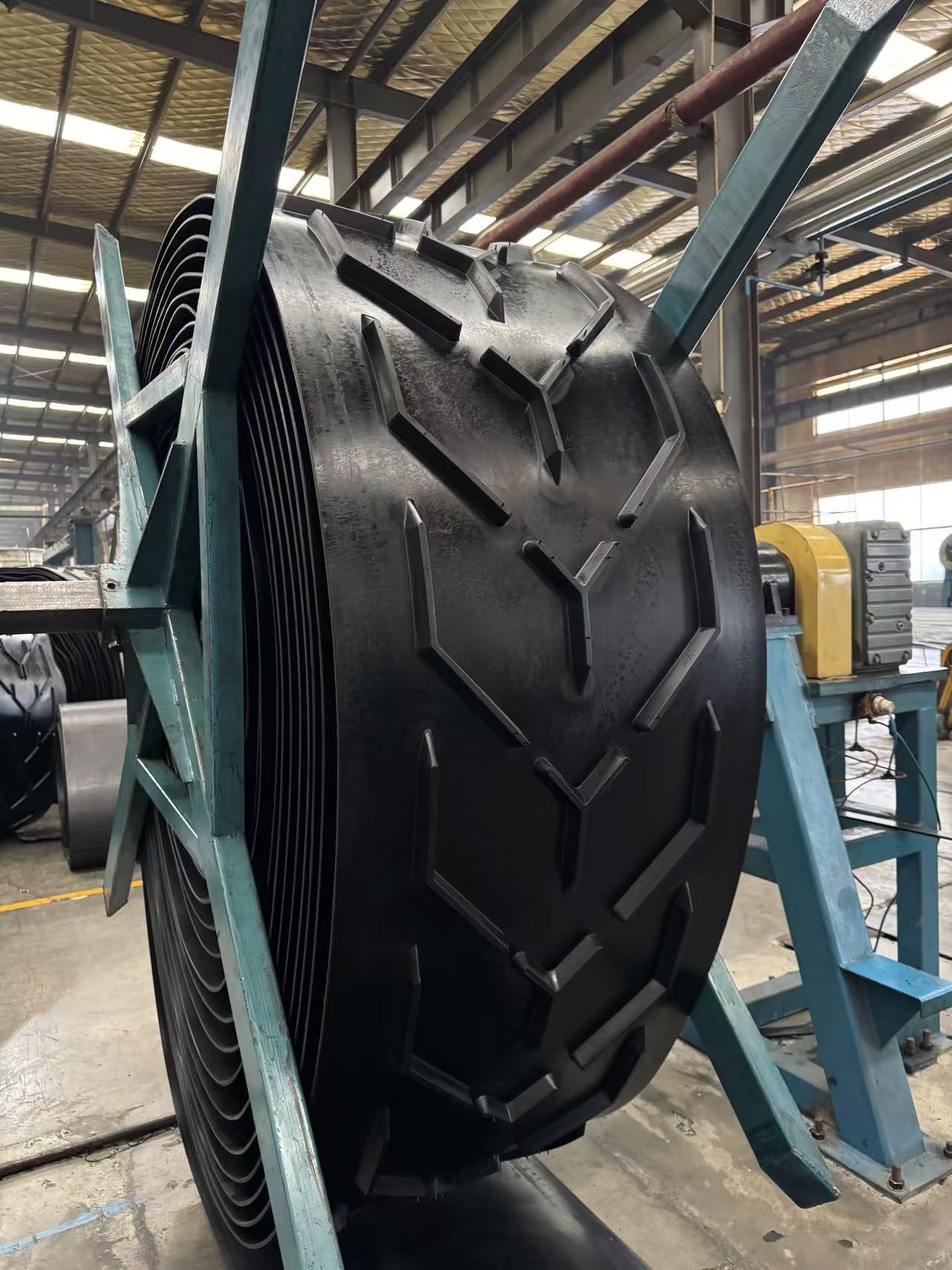
The grip of a conveyor profile starts not in the tread pattern but in the compound itself. Natural rubber and styrene-butadiene rubber are blended to provide a base of elastic deformation, yet it is the filler system that truly sets high-grip formulas apart. A carefully balanced ratio of high-structure carbon black to precipitated silica creates micro-roughness on the contact surface, raising the coefficient of friction without making the compound brittle. Too much silica alone can reduce tear strength, so process oils and coupling agents are used to keep the filler network flexible under load.
Plasticizers are often dismissed as softeners, but in high-grip profiles their role is more subtle. Certain ester-based oils migrate gradually to the surface, forming a thin tacky film that improves initial bite on packaged goods or inclined belts. The cure system matters just as much: over-curing produces a glassy surface that cannot conform to uneven loads, so a semi-efficient vulcanization with antioxidant packages is preferred. This keeps the surface tack alive over months of running without excessive abrasion loss.
For applications where dust, moisture, or light oil films are present, a small addition of carboxylated nitrile rubber or treated reclaimed rubber can lift grip without driving heat build-up too high. The goal is always a balance: enough hysteresis to grip, but not so much that the surface smears and wears prematurely. That is why high-grip compounds are tuned differently for fast flat belts than for steep incline profiles, even when both use the same base polymers.
How Top Chinese Suppliers Test Tear Strength Before Delivery
Most top-tier Chinese suppliers don't treat tear strength as an afterthought. They cut samples from the same roll or lot that will ship, often pulling three to five swatches from different points across the width. The test itself usually follows the Elmendorf pendulum method for woven textiles, where a precise slit is made and the pendulum's energy loss gives a reading in grams or newtons. What separates careful factories is that they test both warp and weft directions, since a fabric that resists tearing along one grain may fail easily along the other.
Beyond the standard single-tear test, some suppliers run a trouser tear method for coated or laminated materials, because it better mimics how a tear propagates under real stress. They also keep a small reference swatch from each batch in a humidity-controlled cabinet for at least 24 hours, as moisture can noticeably lower tear resistance in natural fibers. If a batch comes in close to the lower limit, they don't just average the numbers; they retest a wider sample set and sometimes ask the lab to check for weak points near selvedges.
For buyers, this means the numbers on a test report carry more weight when the supplier can show a traceable link between the tested swatches and the exact cartons being loaded. A handful of factories go further by photographing each cut sample next to its roll number, then sending those photos along with the QC file. It's a small step, but it cuts down on disputes after delivery and signals that the test wasn't run on a specially prepared piece.
Why Some Chevron Belts Outlast Others on Inclined Conveyors
Most operators assume a chevron belt is just a chevron belt, but the real difference in lifespan on inclined conveyors comes down to how the pattern interacts with the specific material being moved. A shallow chevron height might look identical from a distance, yet it allows fine particles to pack into the grooves, turning the belt surface into a slick, abrasive slab within weeks. The belts that last are the ones where the pattern depth, angle, and spacing were actually matched to the repose angle of the load—not just copied from a generic catalog spec.
Rubber compound formulation is another quiet killer. On steep inclines, the belt cycles through rapid flexing around small pulleys while under high tension. Cheap compounds with low tear strength will develop tiny cracks at the base of each chevron within months, then those cracks propagate along the fabric ply until the whole section lets go. You can spot the survivors by looking at the edge of a used sample: long-lasting belts show smooth, even wear on the cleat tips, while early failures show chunking or feathering at the cleat roots.
Finally, installation tension and pulley diameter get overlooked far too often. A chevron belt that's run too loose will slip and scrub against the idler, generating heat that softens the rubber and accelerates wear. Too tight, and the internal fabric plies are stretched beyond their design limit, leading to premature splice failure. The belts that outlast the rest on inclined conveyors are rarely magic—they're just the ones where someone took the time to verify the pattern geometry, compound specs, and tension settings against the actual operating conditions instead of trusting a one-size-fits-all recommendation.
A Closer Look at Custom Cleat Heights and Pattern Spacing
Adjusting cleat height by as little as 2mm changes how pressure moves across the plantar surface. A slightly taller forefoot cleat helps softer ground but can create a fulcrum effect under the metatarsal heads if the heel cleats stay short. Many athletes move between 6mm and 13mm stud lengths depending on whether they need more bite or quicker release.
Spacing between cleats matters just as much as height. Tight clusters of short studs provide even support on firm turf, while wider gaps allow mud and grass to slough off during play. A 10mm gap between the front four studs often works for multi-sport use, but moving that gap to 12mm or more reduces clogging on wet natural grass without losing much lateral stability.
Combining custom heights with non-uniform spacing gives the most natural feel. For example, using 8mm studs in the peripheral forefoot and 11mm under the heel can reduce midfoot strain during hard cuts, especially on partially compacted fields. The pattern itself—whether triangular, oval, or linear—shifts how the foot rotates under load, so small changes in both dimensions often outperform a single dramatic adjustment.
What Overseas Buyers Rarely Ask Before Placing Bulk Orders
Most buyers fixate on unit price and sample quality, then skip the questions that determine whether a bulk order actually survives contact with reality. One they rarely ask is how the factory handles a short shipment or a batch that fails inspection after 40% is already produced. Does the supplier eat the replacement cost, or does the buyer suddenly face an invoice for "unplanned additional materials"? Another overlooked subject is packaging. A product that leaves the factory perfectly fine can arrive with crushed corners because the export carton was specified for domestic trucking, not a month at sea.
Buyers also rarely pin down the true cost of a changed mind. If they adjust the color or add a logo two weeks into production, does the factory charge a small revision fee, or does the entire timeline shift by three weeks because the component needs to be reordered? The answer usually hides in the fine print of the proforma invoice. Asking before payment can save more money than any haggling over a $0.03 per-unit discount.
Finally, few buyers ask for the name of the person who will actually manage their order on the factory floor. They talk to a sales rep who promises daily updates, but after deposit the rep disappears into another trade show. A quick question—"Who is the production coordinator, and can we have a 10-minute call with them before we wire the deposit?"—reveals whether the factory treats the order as a team responsibility or one person's side project.
FAQ
Focus on three things: the rubber compound's abrasion resistance, the consistency of the cleat bonding, and whether the factory can show you real test data from a third-party lab. Don't settle for marketing claims without batch samples.
Yes, most established factories can produce open V, closed V, and multi-height chevron patterns. You'll want to specify the incline angle and material type, because a 30-degree aggregate conveyor needs a taller profile than a grain handling belt.
Mining, cement, grain storage, and port terminals are the heavy users. Many suppliers also serve Southeast Asian and African clients, so their designs often account for high heat and humidity.
Request a small trial roll first, run it on your steepest conveyor for a few weeks, and inspect both the top cover wear and the cleat-to-base adhesion. A reputable factory won't hesitate to send a 50-meter sample for testing.
Standard sizes can ship in 2-4 weeks, but custom width or compound mixing may push that to 6-8 weeks. Always confirm whether the quoted time includes mold setup for non-standard cleat spacing.
Many top-tier ones can meet DIN, ISO, and RMA abrasion standards, but you need to verify certificates against the actual production line. Ask for a factory audit video call or a recent third-party test report rather than just a PDF badge.
They often run 20-40% lower for equivalent spec, but freight and import duties can eat into that gap. Compare FOB versus landed cost, and don't overlook the cost of a failed belt if the compound is under-specified.
Ask about warranty coverage for delamination, cleat tearing, and cover cracking. A solid supplier will replace defective rolls or offer a pro-rata credit without making you jump through excessive paperwork.
Conclusion
Sorting through China’s top chevron belt suppliers reveals a small group that consistently ships to five continents rather than just claiming export readiness. These factories treat the rubber compound as a core advantage: they blend natural and synthetic rubbers with specific fillers to keep the high-grip conveyor profile flexible yet cut-resistant. Before any batch leaves the warehouse, their quality teams run tear strength tests that simulate the repeated tension and impact of inclined conveying, rejecting rolls that show even minor weak points. This combination of actual global delivery records and serious testing separates a handful of manufacturers from hundreds of trading companies.
On steep inclines, the difference between a belt that lasts and one that fails often comes down to custom cleat heights and pattern spacing matched to the material, moisture level, and angle. Top suppliers will ask about your specific bulk density and belt speed before recommending a profile, while many buyers never think to ask about small pulley diameters, cold-weather flexibility, or oil exposure. The best of the top ten will volunteer this data and adjust the cleat design accordingly, because they know a chevron belt is not a one-size-fits-all product. That willingness to dig into application details is usually a better sign of quality than a low unit price.
Contact Us
Contact Person: Anna Lu
Email: [email protected]
Tel/WhatsApp: 8618561668850
Website: https://www.x-conveyor.com