
OEM Stainless Steel Hex Socket Cap Screw Guide for Industrial Fastening
2026-10-02
Ever had a stainless steel hex socket cap screw shear under load or seize after months of exposure? That’s a frustrating reality in industrial fastening when OEM specifications aren’t matched to the application. This guide cuts through the noise, helping you choose the right screw for demanding environments—and it’s why engineers increasingly turn to Wanluo for consistent, corrosion-resistant fasteners.
Why Hex Socket Cap Screws Are the Quiet Workhorses of OEM Stainless Steel Assemblies
In most OEM stainless steel assemblies, the fasteners rarely get a second glance. Designers focus on load paths, finish quality, and cost per unit, while the hex socket cap screw sits there doing its job without complaint. Yet that quiet reliability is exactly why it shows up again and again in everything from food processing equipment to marine hardware. The recessed drive doesn't slip under high torque the way a Phillips or slotted head often does, and the cylindrical head profile keeps the overall envelope tight. You don't need to leave clearance for a wrench swing, just a straight shot for a hex key. That one small advantage alone saves real space in cramped stainless enclosures where every millimeter counts.
Another reason these screws earn their keep is corrosion behavior. OEM stainless assemblies live in washdown environments, salt spray, or chemical exposure. A hex socket cap screw in 316 stainless doesn't just resist rust; it also avoids the crevice corrosion traps created by washers or flanged heads that collect moisture. The unplated, passivated surface stays smooth, and the internal hex doesn't harbor debris as easily as an external hex bolt head. When maintenance crews finally do need to remove a panel after five years, the socket still engages cleanly instead of rounding off. That serviceability translates into fewer damaged threads, fewer stripped extraction jobs, and lower lifecycle cost for the OEM's customer.
Perhaps the most underrated trait is how these fasteners let engineers standardize. A single type of hex socket cap screw can cover mounting brackets, sensor housings, shaft collars, and cover plates across an entire product line. Torque specs stay consistent, inventory stays lean, and assembly workers don't have to switch between screwdriver bits and sockets. In stainless steel work, where galling and thread seizure are constant worries, using a familiar, high-quality socket cap screw with a known friction coefficient makes joint design more predictable. It's not flashy. It won't show up in marketing photos. But every OEM that builds stainless equipment for the long haul knows these screws are doing the heavy lifting, quietly.
Torque Patterns That Stop Stainless Steel Hex Socket Cap Screws from Seizing
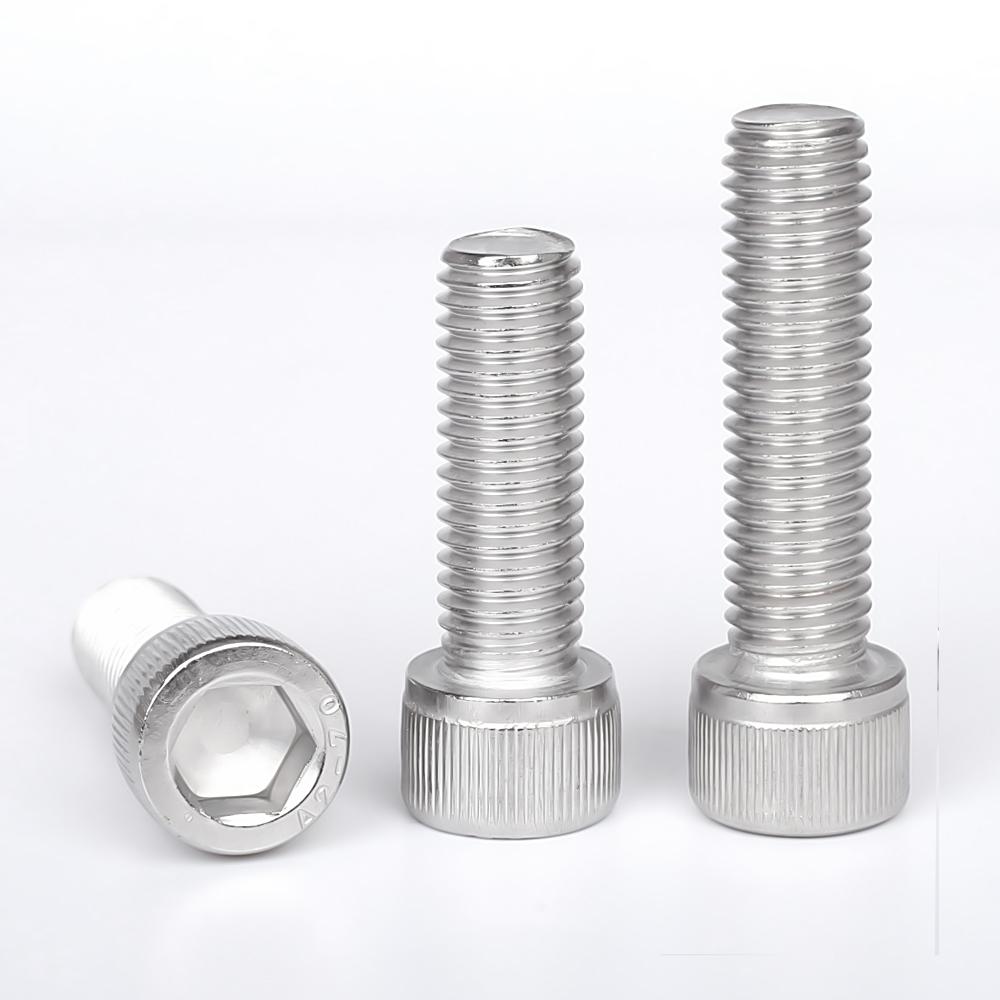
Stainless steel hex socket cap screws have a nasty habit of galling under load, and the usual culprit isn't lubrication—it's how torque gets applied. A single straight shot to full tightness concentrates friction heat at the thread crests, where the passive oxide layer tears and leaves bare metal to cold-weld. The fix starts with a staged pattern: bring every fastener to roughly 30% of target torque in a star or criss-cross sequence, then repeat at 70%, then finish at full spec. This lets the joint settle evenly and keeps any one thread from carrying the entire load while it's still rough.
For a four-bolt flange or cover, never go clockwise around the circle. Use a diagonal pattern—bolt one, then the one opposite, then the adjacent pair across the other axis. On a rectangular housing with six or eight screws, start at the center of the long edge and work outward in alternating steps, never tightening two neighboring screws back-to-back. The goal is to draw the parts together flat, so the clamp load rises uniformly enough that the micro-welds don't have a chance to form before the joint becomes rigid.
If you have a torque wrench with a slow final approach, use it: the last 10% of rotation should take as long as the first 90%. Chatter or stick-slip during tightening is the earliest warning of galling, so back off half a turn and restart with a lower speed. And don't reuse a screw that has already seized once—its threads are compromised, and no torque pattern will save the next assembly. A clean, unplated stainless fastener torqued in a controlled cross pattern rarely needs anti-seize, but if the joint sees heat or frequent disassembly, a thin nickel-based paste on the male threads only is cheap insurance.
Matching Hex Socket Cap Screw Head Styles to Hidden Industrial Fastening Points
Standard hex socket cap screws hide their heads easily inside counterbored holes, but hidden industrial fastening points often demand more than just a flush fit. Low-profile and ultra-low-profile head styles reduce the height above the mating surface while keeping the drive recess deep enough for reliable torque transfer, especially when clearance is tight or a cover plate sits directly over the fastener. Choosing the shorter head means less material protrusion without sacrificing the internal wrenching feature that keeps the tool engagement clean in recessed pockets.
When the hidden point is not a simple counterbore, button head and flat head variants change how the assembly sits against the surrounding structure. A button head socket cap screw offers a slightly domed profile that can sit in a shallow spotface yet still spread clamping force over a wider bearing area than a standard cylindrical head. A flat head socket cap screw, on the other hand, tapers into a conical recess and works best where the fastener head must disappear completely into a chamfered hole, leaving nothing above the outer plane of the panel or bracket.
For truly blind or deeply buried fastening points, the drive style matters as much as the head geometry. Knurled heads and captive washers help when the screw needs to be started by hand inside a narrow housing, while vented heads prevent trapped air from altering torque readings in sealed compartments. Matching the head shape to the recess profile, material thickness, and tool access path prevents cross-threading, stripped recesses, and unintended head protrusion that would otherwise compromise the hidden joint.
How OEM Designers Pick Between 304 and 316 Stainless Steel for Socket Caps
OEM designers rarely start with a stainless steel grade—they start with the environment the socket cap will live in. The conversation usually opens with chloride exposure, temperature swings, or chemical washdowns, because those factors push the decision away from 304 faster than anything else. If the part sits indoors, sees occasional moisture, and never touches salt or aggressive cleaners, 304 is the economical default: it machines predictably, holds tolerances well, and keeps the bill of materials lean.
The real split happens when the application involves coastal air, road de-icing salts, food processing sanitizers, or pharmaceutical clean-in-place systems. In those settings, 316 earns its premium through added molybdenum, which resists pitting and crevice corrosion that would show up as rust spots on 304 within months. Designers also weigh secondary concerns like surface finish requirements, galling risk during assembly, and whether the socket cap needs to match nearby 316 hardware for galvanic compatibility. It is not a simple upgrade—sometimes a coating or a design change on 304 does the job, but for long service life in harsh wet conditions, 316 becomes the safer call.
Cost always sits in the background, yet it rarely drives the final choice alone. A few cents saved per fastener can turn into warranty claims or field failures if the wrong grade corrodes early. Many OEM engineers keep a short internal rule: default to 304 for dry indoor assemblies, switch to 316 the moment salt, chlorine, or acid-based cleaning enters the picture, and document the reasoning so future revisions do not silently swap materials back.
Getting Stainless Hex Socket Caps to Hold Tight with the Right Drill and Tap
Many stainless hex socket caps work loose not because of torque but because the tapped hole offers poor thread contact. Start with the drill size: for most stainless applications, drilling at the upper end of the recommended tap drill range cuts down on tap breakage while still leaving around 70% thread engagement. Use a sharp cobalt or carbide drill, run it slow with steady pressure, and apply tapping fluid meant for stainless.
The tap choice also changes how well the cap screw seats. For through holes, a spiral point tap pushes chips forward and is less likely to clog. For blind holes, switch to a spiral flute tap so chips curl back out. Keep the tap perfectly straight with a guide or machine setup, and clear chips every few turns. Cutting a small chamfer at the hole entrance lets the hex socket cap shoulder sit flat instead of binding on a raised edge.
Once the hole is tapped, clean out all debris and check the fit with a good quality hex key before final assembly. Stainless is prone to galling, so a light coat of anti-seize on the threads helps prevent the screw from cold welding itself in place. Thread engagement depth should be at least one and a half times the screw diameter for a solid hold, and if vibration is a concern, a drop of medium strength threadlocker after degreasing makes a noticeable difference.
Field Failures in Stainless Steel Socket Caps and What Actually Causes Them
Socket caps made from stainless steel often get blamed for failures that have nothing to do with the material itself. In field inspections, we see stripped hex recesses, cracked heads, and sheared threads on a regular basis, and the knee-jerk reaction is to assume the stainless was too soft or defective. But when you pull the torque logs and check the installation tools, the real culprit usually turns out to be a worn driver bit, excessive speed, or a mismatch between the screw size and the required clamp load. Stainless work-hardens rapidly under frictional heat, so a high-speed driver can glaze the recess walls, making the bit slip before the head ever reaches proper seating torque.
Another common field failure is galling, especially in larger diameter socket caps used in outdoor equipment or marine environments. The mating threads look torn and fused, and the bolt snaps during disassembly. That triggers a material complaint, but the root cause is often assembling dry stainless into stainless without any anti-seize or thread lubricant. Without a barrier, the oxide layer gets scraped off under load, and the two surfaces cold-weld at the microscopic level. Once galling starts, no amount of torque control will save the joint. The fix is procedural, not metallurgical: slow the installation speed, use a quality lubricant, and replace any driver bit that shows even minor wear.
Less obvious but equally destructive is hydrogen embrittlement, which catches people off guard because the failure happens hours or days after installation, not during assembly. Socket caps that were electroplated with the wrong bath chemistry or baked improperly can carry trapped hydrogen into the lattice structure. Under sustained tensile stress, the head simply pops off, leaving a brittle, faceted fracture that looks like glass. This gets misdiagnosed as a tensile overload because the cap was tight and the equipment hadn't moved. The giveaway is a batch-related pattern: multiple caps from the same lot failing at roughly the same time, even in low-stress positions. If you send those out for chemical analysis and find no alloy defect, hydrogen is the prime suspect.
FAQ
Stainless hex socket cap screws deliver higher tensile strength per diameter while keeping the head profile low and narrow. The internal hex drive lets you apply more torque without rounding the head, which is critical when you're working in tight machine frames. The stainless alloy also resists rust and chemical attack far better than zinc-plated steel, so fasteners stay intact even around coolants or washdown lines.
For most general industrial work, 18-8 (304) stainless is the default because it balances corrosion resistance and cost. If the assembly sees salt spray, chlorides, or harsh cleaning agents, move to 316 stainless for the extra molybdenum. In high-temperature zones above 800°F, consider 410 or 17-4 PH for better strength retention, but remember they trade away some corrosion resistance.
Nylon patch or pre-applied thread locker is usually the cleanest for production lines since you skip liquid adhesives. For field service or lower volumes, a medium-strength anaerobic adhesive like Loctite 243 works well and still allows disassembly. Avoid fully relying on split washers; they lose tension under dynamic loads and can create false torque readings.
The head diameter is smaller than a standard hex bolt of the same thread size, and the cylindrical shape needs less wrench clearance. That lets you place threaded holes closer to walls, ribs, or other components without sacrificing clamp load. Plus the recessed drive stays engaged at slight angles, which is a real advantage when you can't get a straight shot with a socket.
Generally yes, but don't assume all stainless is equal. 316 stainless handles repeated exposure to moisture, mild chlorides, and cleaning chemicals without pitting. 304 works for covered outdoor areas or occasional splashes but may show tea staining over time. Passivated fasteners also hold up noticeably better than raw machined surfaces, so specify passivation for long service life.
Stainless fasteners typically need about 10-15% lower torque than alloy steel of the same size because the material has lower yield strength and higher friction. Always use anti-seize or a suitable lubricant to keep torque values consistent. If you torque stainless dry to steel specs, you risk galling the threads or stretching the fastener past its elastic limit.
Slow down your driver speed, especially in long thread engagements. Apply a nickel-based anti-seize or a PTFE lubricant to the threads before starting. Avoid reusing the same fastener repeatedly, and never force a screw that starts to feel rough or hot. If you need frequent disassembly, switch to a coarse thread or add a thread insert to reduce metal-to-metal friction.
One mistake is accepting unmarked 304 that is actually 18-8 with inconsistent chemistry, which can crack in cold forming. Another is overlooking dimensional standards: DIN 912 and ISO 4762 have different head heights and drive depths. Also don't skip a salt spray test report if the parts go into food or marine equipment. Cheap stainless fasteners often lack passivation, and that shows up as rust spots within weeks.
Conclusion
Stainless steel hex socket cap screws rarely get much attention on an OEM bill of materials, yet they carry the load in corners where wrench clearance is tight and corrosion resistance is non-negotiable. The internal hex drive lets designers place fasteners close to adjoining surfaces, while head style choices—low, button, or flat socket caps—match the screw to hidden counterbores or low-profile access points without changing thread strength. Material selection usually comes down to 304 versus 316: 304 handles general industrial atmospheres and mild washdowns, but 316 earns its higher cost near chlorides, coastal exposure, or aggressive chemical cleaners. The guide's underlying point is that no alloy choice fixes a poor joint; getting the drilled hole diameter, chamfer, and tap depth right determines whether the engaged threads actually share the load instead of concentrating stress at the first two pitches.
Installation is where most failures begin, and the torque pattern matters more than peak torque alone. Stainless fasteners gall easily when tightened dry or in a rapid cross pattern, so using a stepped star sequence, low-speed tools, and a nickel-based anti-seize or PTFE tape helps prevent cold welding between mating threads. Field failures in socket caps are seldom a clean tensile snap; they are more often a seized shank, a stripped internal hex from a worn bit, or a thread that let go because the pilot hole was oversize or the tap was dull. For OEM assemblies, specifying the right drill and tap combination—typically 60–75 percent thread engagement for stainless—and validating a repeatable torque pattern on actual production parts does more for long-term joint integrity than switching to a stronger but less corrosion-resistant fastener ever would.
Contact Us
Contact Person: Shane
Email: [email protected]
Tel/WhatsApp: 8613357785029
Website: https://www.wanluohardware.com